
Things Every Woman Should Keep in Her Car: A Practical Checklist
A practical three-layer car checklist covering roadside safety, daily essentials, personal needs, smart storage, and seasonal reviews.
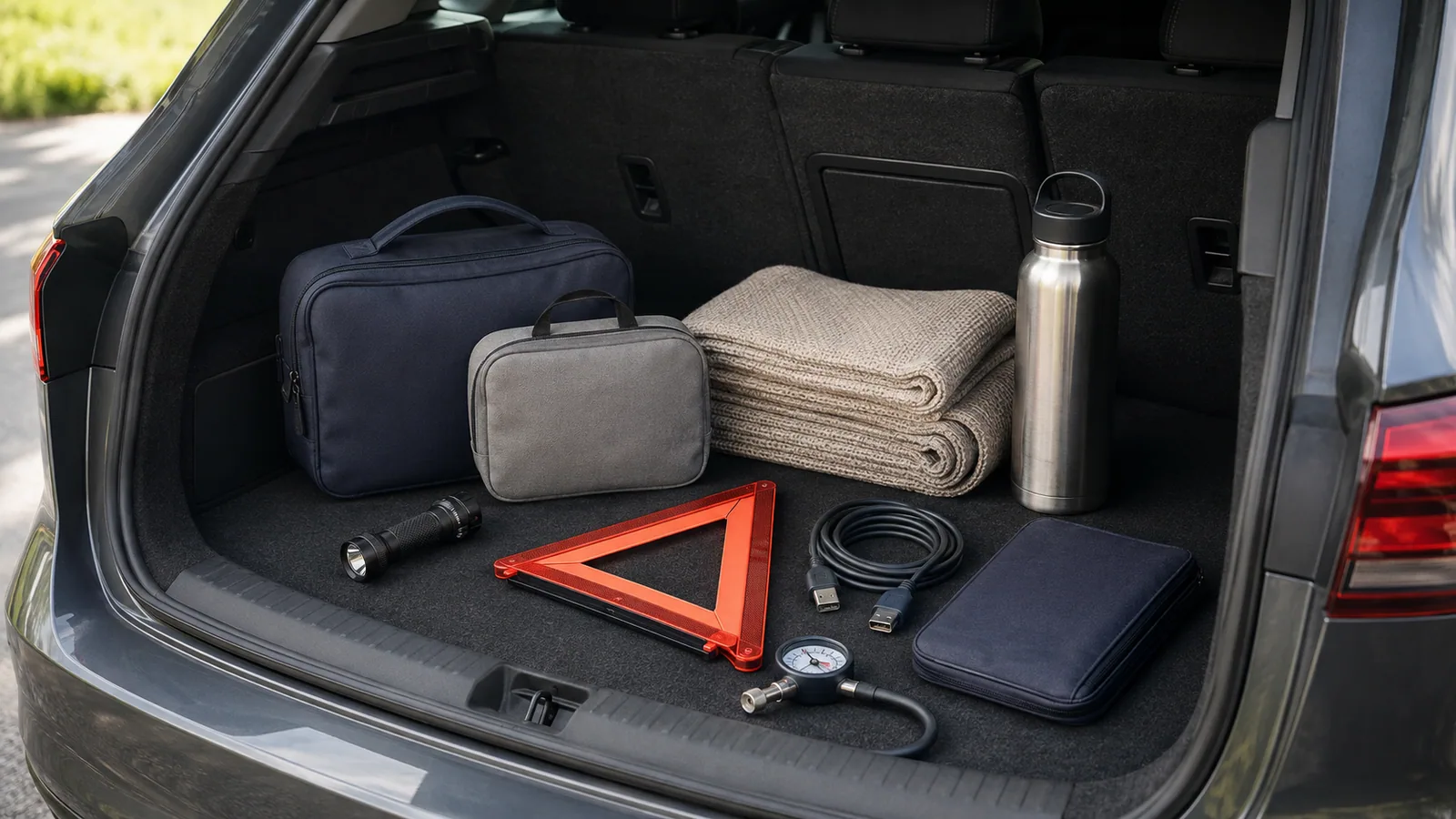
The most useful car checklist is not the longest one. Start with items that help you call for assistance, stay visible, handle a minor problem, and wait safely. Then add a small daily kit based on your routine and climate.
A good setup has three layers: a roadside kit in the trunk, essential documents and tools within reach, and a removable personal pouch. Keeping these layers separate makes them easier to find and review.
If you’re setting up a first car, our new-driver essentials guide can help you decide what to buy first and what can wait.
Layer 1: roadside safety essentials
The National Highway Traffic Safety Administration recommends a charged phone and charger, first-aid kit, flashlight, warning devices, jumper cables, tire-pressure gauge, jack, work gloves, basic tools, water, nonperishable food, and other supplies appropriate to the trip and weather. Its summer driving guidance provides the full reference list.
For a practical everyday kit, begin with:
- A compatible car charger and charging cable
- Flashlight with checked batteries
- Reflective triangles or another legal warning device
- First-aid kit you understand how to use
- Jumper cables or a correctly sized jump starter
- Tire-pressure gauge
- Work gloves
- Drinking water and a small amount of nonperishable food
- Paper towel or absorbent cloth
- Basic emergency contact information
Before buying more tools, open your owner’s manual and inspect the car. Confirm whether it has a spare tire, jack, lug wrench, tire-sealant kit, or manufacturer-specific procedures. A tool is not useful if it is missing a required part or you do not know where the vehicle’s lifting points are.
For a complete setup and seasonal modules, use our car emergency kit checklist.
Layer 2: documents and daily essentials
Keep only items you may need quickly in the glove box or center console:
- Current registration and proof of insurance, stored according to local requirements
- Owner’s manual
- Pen and small notepad
- Spare charging cable
- Tissues and a small waste bag
- Microfiber cloth for glasses or the display
- A small amount of cash if it makes sense for your routes
Avoid turning the glove box into overflow storage. If you cannot reach the paperwork without unloading unrelated items, the system is not working. Use our glove-box checklist to separate required records from items that belong somewhere safer.
Layer 3: a removable personal pouch
Personal needs differ. A compact zip pouch can hold the items that make sense for your routine, such as:
- Period products
- Hair ties
- Unscented wipes or tissues
- Spare contact-lens supplies or glasses, when stored safely
- Stain-removal wipe
- Foldable tote
- Phone battery pack that you remove and recharge regularly
Make the pouch removable. Cars can become extremely hot or cold, and many medicines, batteries, cosmetics, and aerosol products have storage limits. The CDC advises storing medicines properly because some must be kept out of hot places. Check each product’s label rather than assuming it is safe to live in the car. See the CDC’s heat and medication guidance and our guide to what not to leave in a parked car.
Add climate-specific items
Your core kit should stay compact; climate modules can rotate.
Cold and snow
NHTSA’s winter driving guidance adds an ice scraper, snow shovel, traction material, warm blankets, and cold-weather supplies. The National Weather Service also recommends carrying essential medicine with you rather than leaving it in the vehicle.
Heat and long rural routes
Carry additional drinking water for the trip, sun protection you can remove with you, and route-appropriate supplies. Do not treat water stored indefinitely in a hot trunk as your only drinking plan; rotate it and inspect the container.
Children, pets, or frequent passengers
Add supplies for the people or animals who actually ride with you. Secure containers so they do not become loose objects during hard braking.
Store the kit by urgency
Use four simple zones:
- Driver reach: charger, required paperwork, tissues. Nothing should obstruct pedals, controls, mirrors, or airbags.
- Cabin storage: small daily pouch and items safe for the cabin.
- Trunk access: roadside kit, warning devices, gloves, and water.
- Seasonal module: snow, heat, child, pet, or road-trip additions.
If space is limited, our small-car organization system explains how to measure before buying containers.
Review the kit twice a year
Choose two memorable dates—such as the start of summer and winter—and check:
- Flashlight and jump-starter charge
- First-aid expiration dates and damaged packaging
- Food, water, and personal supplies
- Seasonal equipment
- Insurance and registration
- Whether the kit still fits your routes and passengers
The goal is not to prepare for every imaginable event. It is to keep a small, understandable system that you can reach when something ordinary goes wrong.