
What to Keep in Your Glove Box—and What to Store Elsewhere
A practical glove-box checklist for documents, roadside information, and small essentials—plus what should stay at home or leave the car with you.
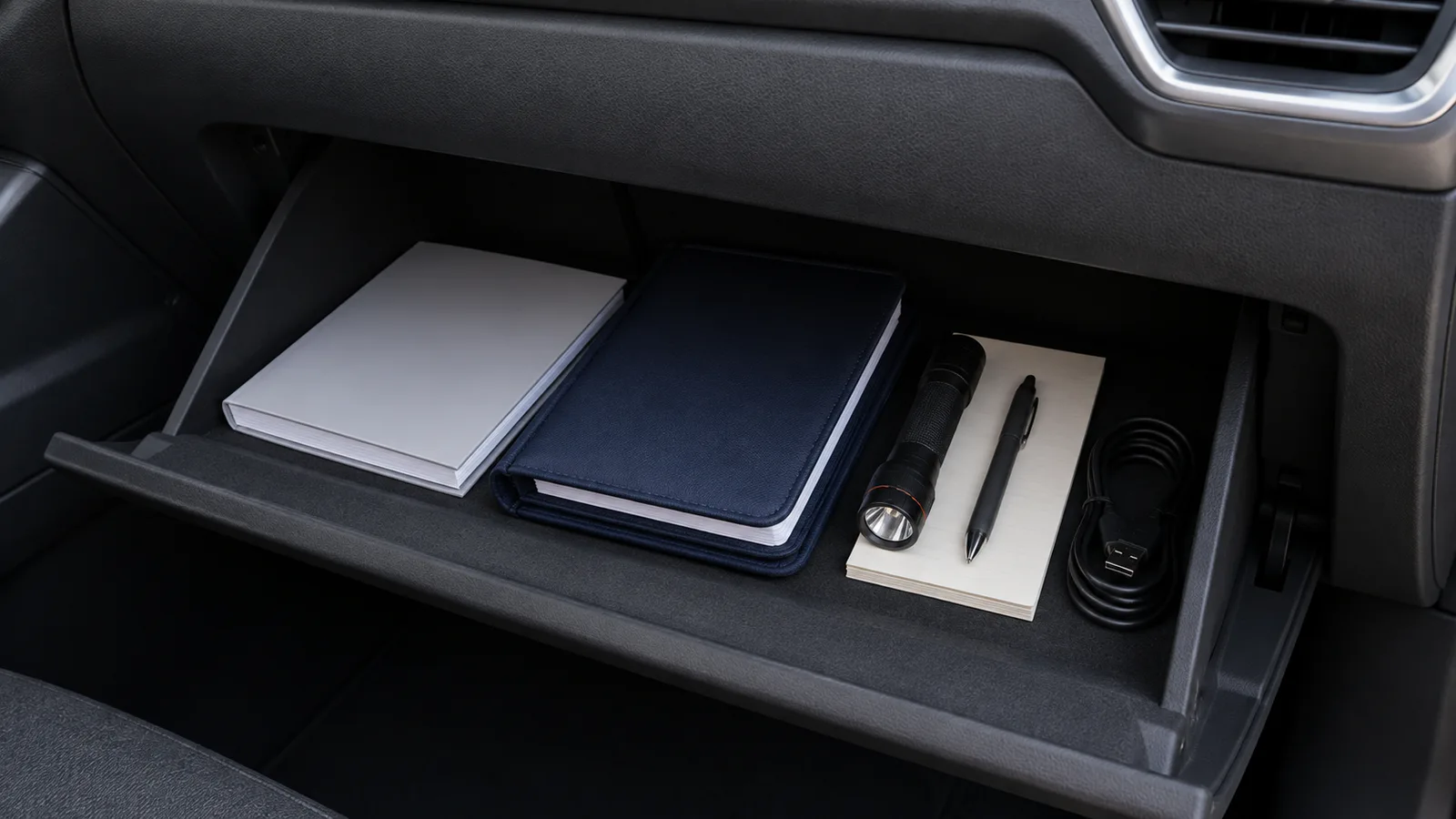
Keep your glove box limited to documents your state requires in the vehicle, the owner’s manual, roadside-assistance information, and a few compact tools you may need while parked. Vehicle titles, passports, spare house keys, valuables, and temperature-sensitive products belong somewhere safer.
The exact paperwork rules vary by state, so treat this as an organization guide—not a substitute for your DMV, insurer, or local law.
Start with the documents your state requires
Create one slim document wallet for:
- Current vehicle registration, if your state requires it in the vehicle
- Current proof of insurance in an accepted paper or digital format
- Roadside-assistance details and membership information
- A short list of useful contact numbers if you cannot access your phone
Review your state DMV and insurer instructions before deciding whether paper or digital proof is sufficient. For example, Nevada’s DMV says the registration and evidence of insurance must be kept in the vehicle, while California requires drivers to be able to provide proof of insurance. Requirements and accepted formats are not identical everywhere.
Do not confuse the vehicle title with the registration. A title proves ownership and can be used in a transfer. New York’s DMV explicitly advises owners to keep the title in a safe place rather than in the car.
Keep the owner’s manual accessible
The owner’s manual can answer vehicle-specific questions that a generic checklist cannot:
- What a dashboard warning means
- Where the jack and approved lifting points are
- Whether the vehicle has a spare tire or repair kit
- Recommended tire pressure and fluid specifications
- How to use safety, towing, or emergency features
If the printed manual is too large for the compartment, keep the quick-reference guide there and save the official digital manual on your phone. Avoid relying on an unverified third-party summary for a safety-critical procedure.
Add a small collision-information kit
A pen and compact notepad remain useful if you need to record a location, witness details, a claim number, or information after a minor collision. Add your insurer’s claims contact and the number for your roadside provider.
This is not a reason to store a folder full of personal records. Keep only the information needed for the vehicle and protect it inside a closed wallet. The Federal Trade Commission recommends locking up important identity and ownership documents and securely disposing of papers that expose personal or financial information.
Choose only a few compact tools
Useful glove-box tools may include:
- A small flashlight with checked batteries
- Pen and notepad
- A charging cable that fits your current phone
- A clean microfiber cloth
- Tissues or a small pack of wipes
- A tire-pressure gauge, if it fits without hiding the documents
Larger first-aid supplies, jumper cables, warning triangles, work gloves, and climate gear belong in an accessible, secured roadside kit. Our car emergency kit checklist explains how to organize those items without overloading the cabin.
What not to keep in the glove box
The vehicle title and identity documents
Keep the original title, passport, Social Security card, birth certificate, and unrelated financial records secured outside the vehicle. A glove box is convenient, but it is not a safe.
Spare house keys and visible valuables
A vehicle break-in becomes more damaging if a thief also finds a house key, address information, wallet, or electronic device. NHTSA recommends keeping valuables hidden and removing tempting personal items from view.
Medicines and temperature-sensitive products
The FDA advises against leaving medicine in a car during summer or winter because extreme temperatures can affect how well it works. Carry necessary medicine with you and follow its label or pharmacist’s storage instructions.
Bulky emergency tools
If the glove box cannot open normally or the documents are buried, move the excess to a secured trunk container. Do not force heavy tools or containers into a compartment that was not designed for them.
Use a simple three-part system
- Document wallet: registration, insurance information, and roadside contacts.
- Vehicle reference: owner’s manual or official quick guide.
- Small utility pouch: pen, notepad, cable, cloth, and flashlight.
Everything should come out in one of those three groups. If loose receipts and expired cards return every week, add a short reset to your clean-and-organized car routine.
Review it every three months
- Remove receipts, expired insurance cards, and unrelated papers.
- Confirm the registration and insurance information are current.
- Test the flashlight and inspect batteries for damage.
- Replace dried wipes and broken charging cables.
- Return medicines, valuables, and personal records to safer storage.
- Check that the compartment closes without pressure.
A good glove box is deliberately boring: the right paperwork, accurate vehicle information, and a few small tools you can find quickly.