
Laundry Room Storage: Choose the Right Storage Type
Compare laundry room storage types by access, footprint, retrieval steps, mobility, service access, visibility, and safety before you buy.
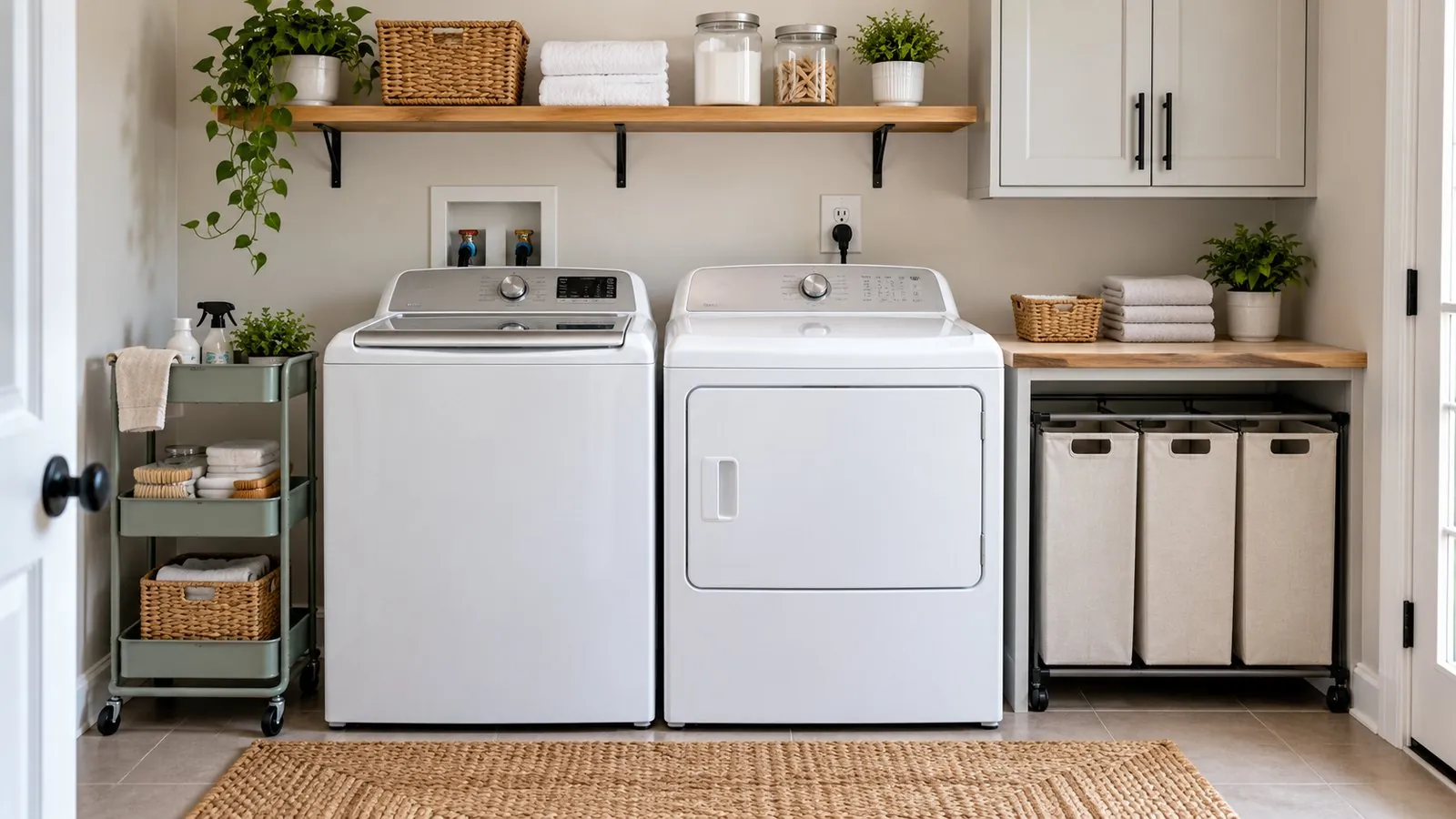
The best laundry-room storage is not the option that fills the most empty space. It is the option that solves one repeated laundry problem without adding another step, blocking the machines, or making service access harder.
Before you buy a shelf, cabinet, rolling cart, hamper, or wall organizer, name the storage job first. Then compare the storage types by access frequency, space cost, retrieval friction, mobility, visibility, and safety.
If the whole room still feels disorganized, start with the Laundry Room Organization measurement-first system. This guide is for the next decision: what kind of storage should solve the problem?
Start with the storage job
“Need more storage” is too broad to make a good buying decision.
Finish this sentence instead:
I need a place for ___ so that ___ stops happening.
Examples:
- I need a place for detergent so I stop moving it off the dryer every load.
- I need a dirty-clothes intake zone so hampers stop blocking the doorway.
- I need a home for back stock so daily supplies stop disappearing behind refill bottles.
- I need a narrow movable unit so small supplies stop collecting on the floor beside the washer.
- I need closed storage so hazardous or visually noisy supplies are not left exposed.
One storage product should have a clear job. If a unit is expected to hold daily detergent, cleaning chemicals, spare towels, tools, ironing supplies, paper goods, and unrelated household overflow, the problem is probably not “insufficient capacity.” It is mixed ownership.
Run the Storage Fit Test
Compare any candidate with these six questions.
| Test | Ask | What a good answer looks like |
|---|---|---|
| Job | What repeated failure does this solve? | One clear problem, not generic “more storage” |
| Access frequency | Every load, weekly, or back stock? | Prime reach goes to high-frequency items |
| Space cost | What wall, floor, gap, swing, or work zone does it consume? | It uses space that is not needed for machine operation |
| Retrieval friction | How many things must move before the item is usable? | Daily items come out and go back in one simple motion |
| Mobility/service impact | Can it move when the appliance or utilities need access? | Service access remains practical |
| Visibility/safety/reset | Should contents be visible, concealed, secured, or easy to reset? | The storage behavior matches the household |
A storage type that wins five categories but fails machine access is still the wrong type.
Whirlpool’s current laundry-room sizing guidance emphasizes that room planning includes hookups, ventilation, appliance openings, and model-specific instructions—not just the washer/dryer cabinet dimensions. Treat those operating requirements as fixed constraints around which storage must work.
Quick storage-type comparison
| Storage type | Best fit | Main cost | Avoid when |
|---|---|---|---|
| Open shelf | Frequently used light supplies that benefit from visibility | Wall depth and visual exposure | The wall conflicts with appliance opening or supplies need secure storage |
| Closed cabinet | Supplies that benefit from concealment or controlled access | Permanent wall depth, doors, higher commitment | Door swing or cabinet body crowds the task zone |
| Narrow rolling cart | Small supplies in a usable side gap | Floor/gap space and pull-out path | It traps service access or cannot roll out when loaded |
| Hamper or sorter | Dirty-intake and sorting jobs | Floor footprint | It parks in a door, appliance, or basket path |
| Wall rail/hooks | Small tools, hangers, or air-dry accessories | Wall surface and hanging drop | Hanging items obstruct machines or circulation |
| Freestanding over-appliance rack | Vertical storage without permanent wall mounting | Side legs/braces and fit constraints | Crossbars, shelves, or legs conflict with controls, lids, or hookups |
| Back-stock zone | Infrequent refills | Distance from point of use | It crowds prime daily space merely because the room has an empty corner |
The comparison is not about which type is “best” overall. It is about which one has the lowest cost for a specific job.
Choose open shelves when visibility is the advantage
Open shelving works well when you use the contents frequently and being able to see them saves time.
Good candidates include:
- routine laundry supplies;
- lightweight baskets holding small nonhazardous items;
- empty hangers;
- folded utility towels, if they are genuinely used here.
The tradeoff is that open shelves expose everything and can encourage the room to become overflow storage.
They also have geometry constraints. Shelf depth, reach, top-loader lid movement, and the space required to lift an item off the shelf all matter. If you have already decided that shelving is the right storage type, use the separate guide to plan laundry-room shelving around the real appliance opening.
Choose a shelf because visibility and quick retrieval help the task—not because the wall looks empty.
Choose closed cabinets when concealment or controlled access matters
A cabinet earns its space when a door changes the storage behavior in a useful way.
That can mean:
- reducing visual clutter;
- separating back stock from daily supplies;
- keeping some household products behind a closed or lockable barrier;
- protecting contents from dust.
The cost is commitment.
A wall cabinet permanently consumes depth. Its door requires opening space. A base or tall cabinet can consume floor space and circulation. Installation can also make appliance-service access harder if the layout is too tight.
At this stage, do not choose a cabinet by style. First decide whether closed storage solves a problem that an open or movable option cannot. If cabinetry is justified, compare wall, base, tall, sink-base, and over-appliance laundry-room cabinet forms before you commit the space.
Choose a narrow rolling cart when mobility is part of the solution
A rolling cart can be useful when a narrow side gap exists but should not be permanently filled.
The key word is rolling.
A cart only earns the mobility advantage if it can actually be pulled out while loaded.
Before buying one, measure:
- the usable gap at the narrowest point;
- the cart’s complete width, including handles, wheel housings, or side frames;
- the pull-out path in front of the gap;
- any baseboard, hose, door, or wall obstruction;
- whether the gap is needed for cleaning or service.
Then imagine the cart loaded with the heaviest normal items you expect to keep there.
If you would need to unload half the cart before moving it, treat it as fixed storage—not mobile storage.
This is why laundry room rolling cart and storage between washer and dryer belong inside the storage-type decision instead of becoming separate idea pages.
Use the washer-dryer gap only if the gap has no more important job
A narrow gap can look like wasted space, but it may be doing work already.
Ask:
- Is the gap part of model-required side clearance or airflow?
- Does it help reach hoses, valves, plugs, or the dryer vent?
- Do the appliances move or vibrate close to the gap?
- Can the proposed cart slide out without moving another object?
- Can the area still be cleaned?
- Will stored products stay stable when the machines run?
Do not copy a gap width from a product listing or another laundry room. Use the installation instructions for your machines and the actual room.
If the gap is truly usable, a narrow cart can be efficient because it turns a small floor strip into movable storage. If the gap is service space, the “storage solution” is to leave it open.
When the room is so tight that the machine openings, room door, basket path, and service zones overlap, step back from the product choice and use the Small Laundry Room Organization constraint-first layout to decide whether that gap should be storage at all.
Choose hampers and sorters when the problem starts before washing
A hamper is storage, but its job is different from a shelf or cabinet.
It controls dirty intake.
A good hamper position answers:
- Where do dirty clothes enter?
- Does sorting happen before or after they reach the laundry room?
- Can a full hamper reach the washer without blocking a door?
- Where does the empty hamper park while a load is running?
A larger multi-bin sorter is not automatically better.
If it has to be pushed out of the doorway every time you use the dryer, it has created another step. A smaller single hamper, two compact bins, or a sorter outside the laundry room may fit the workflow better.
Choose wall rails, hooks, or hanging organizers for narrow tasks
Wall-mounted organizers are useful when the storage job is small and specific.
Examples:
- a few empty hangers;
- a lint brush;
- an ironing accessory;
- a small air-dry item;
- a lightweight laundry bag.
They cost little floor space, but hanging items create their own clearance envelope.
A garment or bag can swing into a door, control panel, top-loader lid, or walking path. Test the organizer loaded, not empty.
For anything load-bearing, follow the hardware manufacturer’s mounting and capacity instructions instead of guessing at wall-anchor strength.
Choose a freestanding over-appliance rack when low commitment matters
An over-washer rack can add vertical storage without permanently mounting shelves or cabinets.
That makes it attractive for rentals or rooms where you want reversibility.
But a freestanding rack has more geometry than the product photo suggests:
- side legs need floor space;
- braces may cross behind the machine;
- shelves may conflict with a top-load lid;
- the frame may hide controls;
- feet may meet baseboards or trim;
- the rack may complicate service access.
Measure the inside dimensions and all structural members, not just the advertised overall width.
If the rack is mainly a shelving decision, use the shelving guide for the detailed operating-envelope test.
Give back stock a lower-priority zone
Back stock should not compete with every-load supplies for the easiest storage.
If you buy detergent, dryer products, or household cleaners in multiples, keep only the amount needed for routine use in the prime zone.
The rest can move to:
- a higher or less convenient shelf if safe and reachable;
- a closed cabinet;
- another utility-storage area;
- a nearby closet.
The correct answer may be outside the laundry room.
Every refill kept in the room consumes capacity and increases reset work. Prime laundry storage should support the laundry cycle, not function as a general household warehouse.
Treat chemical storage as a separate requirement
Do not choose an attractive open-storage system and then force hazardous products into it.
The U.S. Consumer Product Safety Commission says laundry packets should remain in their original containers and out of a child’s sight and reach in its poison-prevention guidance. Its poison-prevention guidance also says household chemicals and cleaning supplies should be safely stored, including locked storage where appropriate.
That has two practical consequences:
- Do not broadly decant laundry packets or hazardous cleaning products into decorative containers just to make open storage look uniform.
- If your household needs locked storage, that requirement can rule out an open shelf or cart even if it is convenient.
Safety requirements can change the storage type before aesthetics enter the decision.
Keep dryer access and venting out of the storage plan
Do not turn the area behind the dryer into hidden storage.
The U.S. Fire Administration recommends checking the venting system behind the dryer so it is not damaged, crushed, or restricted in its clothes-dryer fire-safety guidance, and cleaning where lint can build up.
A cart, cabinet, or pile of back stock should not make that inspection impractical.
USFA also advises in its appliance and electrical fire-safety guidance that major appliances such as washers and dryers be plugged directly into wall outlets rather than through extension cords. Storage should work around the proper power connection, not create a reason to reroute it.
Count retrieval steps before you buy
For a daily item, count every motion required to use it.
Example A:
- Open cabinet.
- Pull out basket.
- Move refill bottle.
- Grab detergent.
- Put refill back.
- Return basket.
- Close cabinet.
Example B:
- Grab detergent.
- Return detergent.
The second system uses less storage “organization” but has lower retrieval friction.
This does not mean everything should stay visible. It means the number of steps should match the access frequency.
A weekly or hazardous item can justify extra steps. An every-load item usually should not.
Run a seven-day loaded storage test
Do not judge storage while it is empty and staged.
Use the room for a normal week and track:
- which items land on top of the machines anyway;
- which storage has to move before another task;
- which drawer, door, or cart stays open because closing it is inconvenient;
- which daily item gets left out instead of returned;
- which hamper blocks a path when full;
- whether a cart still rolls when loaded;
- whether service points remain reachable;
- whether back stock expands into the daily zone.
Then remove or change the storage type that creates the most repeated friction.
Common storage-type mistakes
Buying capacity before defining the job
A large unit seems efficient because it holds many things.
Problem: unrelated categories migrate into it and the laundry room becomes overflow storage.
Better: define the job first and size the storage around that job.
Using fixed storage for a temporary space
A cabinet or built-in unit occupies space all the time even if the item is used only occasionally.
Better: use movable or off-room storage when the job does not justify permanent floor or wall cost.
Using open storage for items that need security
Visibility is useful until the contents should not remain accessible.
Better: let safety requirements determine whether closed or locked storage is necessary.
Treating “rolling” as automatically mobile
A narrow cart may fit the gap but become too heavy, blocked, or awkward to pull out.
Better: test the loaded pull-out path before treating mobility as a benefit.
Filling every appliance gap
A gap may be required for operation, airflow, cleaning, or service.
Better: prove that the gap is usable storage space before occupying it.
The best storage type removes a step
A good laundry-room storage decision should make a repeated task simpler.
Choose open shelves when visibility and fast reach are the advantage. Choose closed cabinets when concealment or secure access is the real job. Choose a rolling cart when mobility genuinely preserves a useful side gap. Choose hampers when dirty intake needs a home. Choose wall organizers for narrow tasks. Move back stock away from prime space when frequency does not justify it.
Then use the room loaded for a week.
If the storage reduces the number of things you move before washing, drying, folding, or resetting the room, it is doing its job.