
Laundry Room Shelving: Plan the Usable Shelf Zone
Plan laundry room shelving by measuring appliance openings, service access, reach, container depth, and hanging space before you mount a shelf.
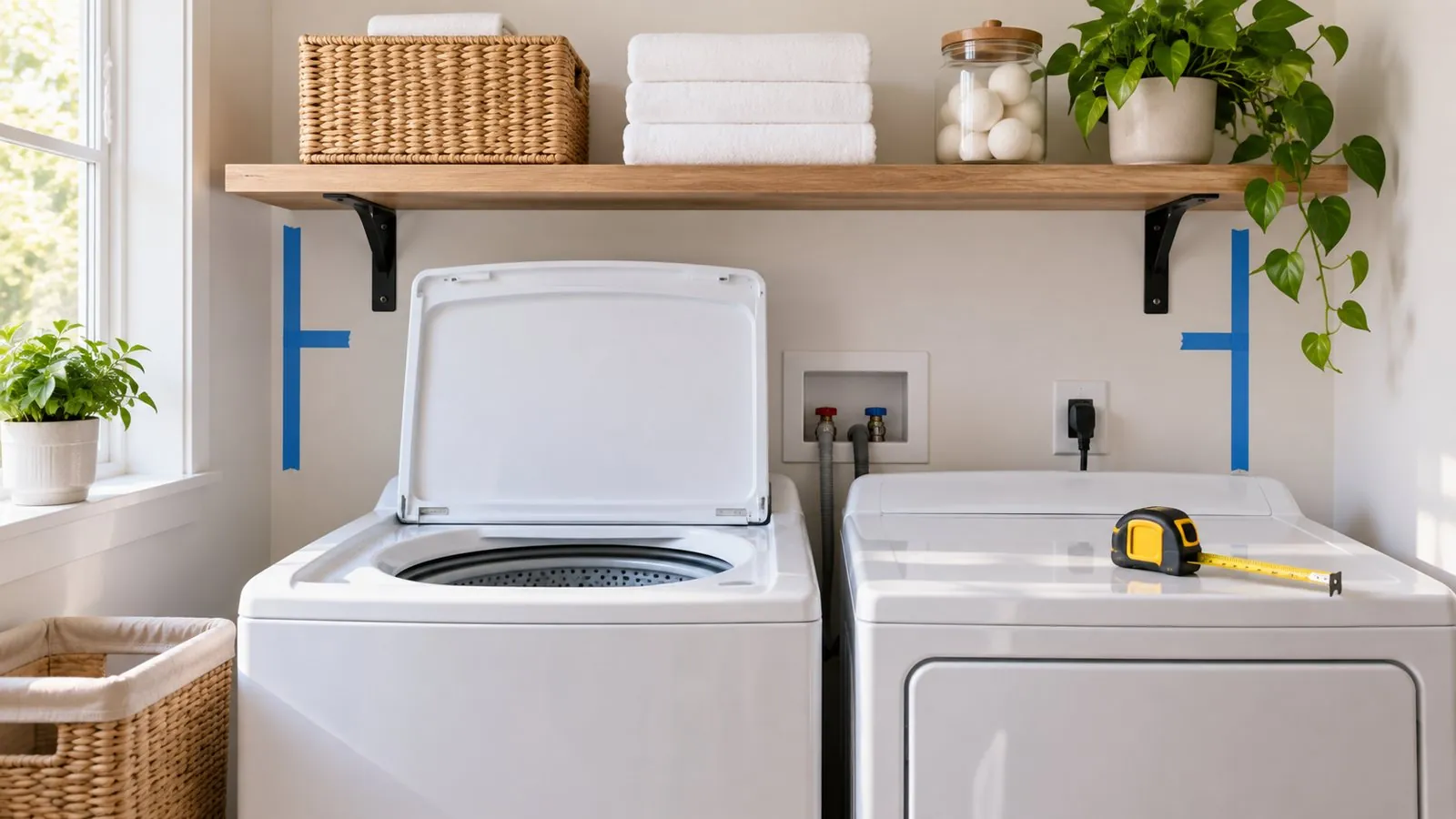
A laundry-room shelf is useful only if you can still open the machine, reach the controls, remove the stored item, and get to the service points behind or beside the appliances.
So do not start with a generic shelf-height rule. Start by finding the usable shelf zone: the part of the wall left after you account for the appliance opening, service access, your reach, the containers you plan to store, and any hanging clothes.
If you are still planning the whole room, start with the Laundry Room Organization measurement-first system. Use this guide when the next problem is specifically where shelves can go.
Find the usable shelf zone before choosing a shelf
Measure the wall with the machines in their real operating positions.
| Measure | What to record | Why it matters |
|---|---|---|
| Appliance body | Width, depth, and top height | Shows the occupied footprint |
| Opening envelope | Highest or widest point of a lid or door while fully open | Prevents a shelf from blocking loading |
| Controls | Where your eyes and hands need to reach | Keeps a shelf or stored bin from hiding controls |
| Service points | Valves, hoses, drain, plug, dryer vent, access panels | Avoids turning routine service into a shelf-removal job |
| Usable wall width | Clear wall after doors, trim, cabinets, and obstructions | Defines the real mounting span |
| Stored-item depth | Deepest bottle, bin, or basket planned for the shelf | Prevents an unnecessarily deep shelf |
| Removal height | Space needed to lift the tallest stored item off the shelf | Tests the shelf loaded, not empty |
| Hanging drop | Length from rod to bottom of a real garment | Keeps clothes out of doors, lids, controls, and work surfaces |
Whirlpool’s current laundry-room sizing guidance notes that appliance specifications and installation instructions affect the final layout, and it specifically calls out overhead opening space for top-load washers. Treat the manual for your exact washer and dryer as the final reference rather than copying a room-photo dimension.
Mark the appliance opening envelope
Open every moving part before you mark a shelf line.
For a top-load washer, raise the lid fully and measure the highest point it reaches. Check whether the lid changes angle as it opens and whether your hand needs more room to load bulky items.
For a front-load machine, the shelf usually does not conflict with the door itself, but loading still has a body-and-basket zone. A deep low shelf can make you lean into the machine or hit your head while reaching into the drum.
For a stacked pair, the machines already occupy the prime vertical zone. An overhead shelf may technically fit and still be too high for routine supplies. Side-wall shelving can be the more usable option.
The shelf belongs outside the operating envelope, not merely above the appliance cabinet.
Protect the service zone
A wall can look empty while still being functional space.
Before mounting anything fixed, identify:
- water shutoff valves;
- inlet hoses and drain connection;
- electrical plugs;
- dryer exhaust route;
- any access panel your appliance instructions say must remain serviceable.
Do not build a shelf system that requires unloading and dismantling the whole wall just to inspect a hose or reach a shutoff.
This does not require one universal empty gap. It requires a plan that respects the exact appliances and connections in your room.
Size shelf depth around the item, not the wall
A deeper shelf is not automatically more useful.
Measure the deepest item you actually want to store there. Then check two motions:
- Can you see and grip the item without moving unrelated items?
- Can you lift it off the shelf without hitting the shelf above, ceiling, or cabinet trim?
If the shelf is much deeper than the stored item, small bottles migrate to the back and daily retrieval gets harder. If the shelf is too shallow, large bottles sit near the edge or do not fit at all.
Use depth to solve a storage problem, not to consume all available wall depth.
Give the best reach to every-load supplies
The easiest shelf should hold the things you use most often.
That usually means routine detergent or treatment supplies, but the exact items depend on your household. Back stock and rarely used products can move to a less convenient zone.
Do not create a layout that makes you:
- reach above shoulder level for a heavy container every load;
- lean across the machine to grab a bottle from the back;
- stand on the washer or dryer;
- move a decorative bin before accessing a daily product.
An empty high shelf is not wasted space if filling it would make the room harder or less safe to use.
Choose the shelf form after the zone is known
If you are still deciding whether shelves are the right storage form at all, compare laundry-room storage types before committing to wall or floor space.
Wall-mounted open shelf
Best when you have a clear wall, predictable storage needs, and a mounting method appropriate for the wall and expected load.
Strengths: simple access, little floor use, flexible visual width.
Tradeoffs: fixed position, exposed contents, and installation or load limits that depend on the shelf and wall system.
Follow the shelf or bracket manufacturer’s mounting and load instructions. Do not guess at anchor capacity.
Adjustable track or rail shelving
Best when item heights may change or you want to tune shelf spacing later.
Strengths: shelf levels can be moved; easier to adapt than a permanently fixed stack.
Tradeoffs: still needs proper wall attachment, and the vertical tracks can conflict with valves, cabinets, backsplash details, or trim.
Freestanding over-washer rack
Best when drilling is not desirable and the rack genuinely clears the machines and surrounding room.
Strengths: lower installation commitment; multiple shelves and sometimes a rod.
Tradeoffs: legs consume side space, crossbars can conflict with controls or lids, and nominal “fits over washer” dimensions do not guarantee compatibility with your machines.
Measure the rack’s inside width, shelf heights, feet, braces, and wall-clearance needs—not just its overall width.
Shelf plus hanging rod
Best when air-dry or ready-to-hang garments are part of the laundry workflow.
Strengths: combines supply storage and hanging in one wall zone.
Tradeoffs: hanging clothes create a moving vertical obstruction.
Hang one of your longest normal garments during the mock-up. If it drops across a lid, control panel, door, folding surface, or walking route, the rod is in the wrong zone.
How appliance configuration changes the shelf plan
| Configuration | What to test first | Shelf implication |
|---|---|---|
| Top-load washer | Fully open lid and loading hand space | Shelf height is controlled by the real lid or opening envelope, not a generic photo |
| Front-load side-by-side pair | Controls, leaning or loading posture, wall width | Above-machine shelves can work well if depth and reach remain comfortable |
| Stacked pair | Overall appliance height and reachable wall | Overhead shelves may be poor daily storage; side shelving may be more useful |
| Machines under existing cabinets | Cabinet underside, door swing, controls | A narrow shelf may not add enough value to justify crowding the gap |
| Appliance beside a clear side wall | Basket path and side service access | Side-wall shelves can avoid the most crowded zone above the machines |
Whirlpool’s washer and dryer sizing guide provides general planning examples, but exact clearances vary by model and installation. Use the manual for your appliances before fixing a shelf position.
A shelf over the washer and dryer should pass this test
The wall directly above the machines is valuable because it is close to the task. It is also the easiest place to create a conflict.
Before buying or installing an over-washer shelf, confirm:
- The washer lid or door can reach its full operating position.
- Controls stay visible and usable.
- The stored item fits the shelf depth.
- The item can be lifted off the shelf without another surface blocking it.
- The shelf does not make service points impractical to reach.
- The daily-use shelf is reachable without standing on an appliance.
- A hanging rod, if present, does not drop garments into the operating zone.
If one of those fails, change the shelf height, depth, location, or type before drilling.
Treat detergent storage as a safety decision too
If children may access the laundry area, shelf placement is not the only safety control.
The U.S. Consumer Product Safety Commission advises keeping laundry packets in their original containers and out of a child’s sight and reach in its poison-prevention guidance. Its childproofing guidance also recommends locks or latches where needed to prevent access to laundry detergent and household cleaners.
Do not assume that a visually high open shelf is equivalent to secure storage for every household. If locked storage is needed, that requirement may move hazardous products out of the open-shelf plan entirely.
Mock up the shelf before drilling
Use painter’s tape, cardboard, or a scrap board to represent the proposed shelf face and depth.
Then run a loaded test:
- Open the washer or dryer fully.
- Stand where you normally load it.
- Bring in a laundry basket.
- Put the actual bottle or bin at the proposed shelf location.
- Reach for it as you would during a normal load.
- Lift it up and off the shelf.
- If adding a rod, hang a real garment.
- Check valves, hoses, plugs, and vent or service access again.
A five-minute mock-up can reveal a bad shelf position before it becomes holes in the wall.
Common shelving failures
The shelf is sized for the room photo, not the machine
A styled image may show a shelf close to a washer because that particular appliance, angle, or household allows it. Your machine may not.
Fix: measure the full operating envelope of your exact appliance.
The shelf is too deep
More depth can reduce visibility and force you to lean farther over the machine.
Fix: size the shelf around the deepest item you genuinely need there.
The top shelf becomes overflow storage
Infrequent products accumulate until the shelf is heavy, crowded, and hard to reset.
Fix: keep back stock limited and move unrelated household overflow elsewhere.
A rod blocks the work zone
The rod fits the wall, but hanging shirts occupy the same space needed to open a lid or fold clothes.
Fix: test with a real garment before installing the rod.
A freestanding rack fits on paper but not in the room
The advertised width may ignore baseboards, hoses, control panels, side gaps, or the rack’s own braces.
Fix: compare the rack’s complete footprint with the room and appliance operating envelope.
The goal is usable wall space, not maximum shelf count
The best laundry-room shelving plan does not fill every inch above the machines. It creates a small number of shelf positions that remain reachable, safe for the household, and compatible with the machines when the room is actually in use.
Measure the operating envelope first. Protect service access. Size shelf depth around real items. Keep frequent supplies in the easiest reach. Then test the layout loaded before you install it.
That is the difference between shelves that photograph well and shelves that keep working through an ordinary laundry week.
If the shelf decision is only one part of a tight closet or narrow room where the door, basket path, and appliance openings compete for the same space, use the Small Laundry Room Organization constraint-first layout before adding more wall storage.