
Small Bedroom Closet Organization as One Room System
Organize a small bedroom closet by deciding what belongs in the closet, under the bed, in drawers, or outside the room—while keeping daily access simple.
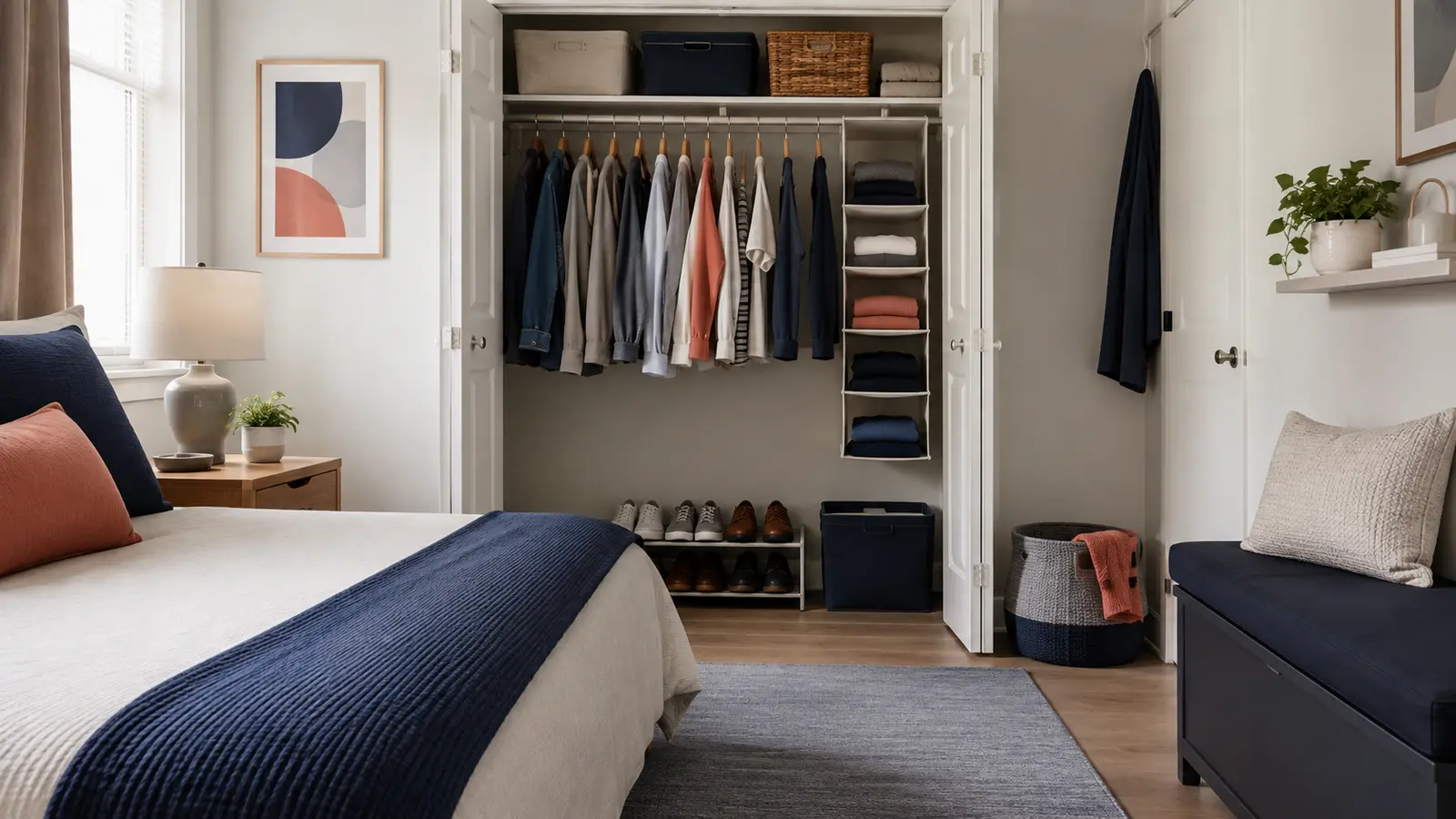
A small bedroom closet is easier to organize when you stop asking it to hold every clothing-related item. Treat the closet, dresser, under-bed area, hooks, and laundry path as one system, then give each category the location that makes daily use simplest.
Map the bedroom’s storage jobs
List every available space and what it does well:
- Closet rod: wrinkle-prone and current-season hanging clothes
- Closet shelves: folded items and visible accessories
- Dresser: small or private categories
- Under-bed storage: protected, low-frequency items
- Wall or door hook: one or two active items, not overflow
- Laundry basket: the transition between worn and clean
If two locations compete for the same category, choose one primary home. Duplicate storage rules create duplicate piles.
Keep the daily wardrobe closest
Place the current rotation where it can be reached without kneeling, lifting a lid, or moving another item. Occasion wear and off-season clothing can tolerate less convenient positions.
This is an access decision, not a judgment about how often an item “should” be used.
Decide what leaves the closet
The closet should not automatically hold luggage, spare bedding, documents, hobby supplies, and every season of clothing. Move a category only when the new location is dry, appropriate for the material, and realistically accessible.
Under-bed boxes work best for clean, protected, occasional items. Measure the bed-frame clearance and the box handles; a container that fits vertically but cannot be pulled past a rug or nightstand is not usable storage.
Prevent the chair-pile loop
Bedroom clutter often appears between storage states: clothes are not clean enough for the closet, not ready for laundry, or waiting to be put away.
Choose one intentional transition point:
- A small open basket for re-wear items
- A limited number of hooks
- A defined section of the laundry sorter
Keep the capacity small. When it fills, reset it instead of adding a second holding zone.
Coordinate closet and dresser categories
Store categories together where possible. For example, if everyday tops fit better folded, give them one dresser drawer rather than splitting them between a shelf, hanging rod, and under-bed box.
Use the closet shelf organization guide when stacks and bins are the failure point. If the closet opening hides side areas, the reach-in layout guide will help place daily items in the visible center.
Protect the walkway and door swing
Bedroom organizers affect more than storage. Mark the full travel of closet doors, dresser drawers, room doors, and under-bed containers. Preserve the path used at night and avoid placing baskets where they become trip hazards.
Tall freestanding clothing-storage furniture should be installed and anchored according to its instructions and current CPSC furniture-safety guidance.
A 20-minute room-wide reset
- Return clean clothes to their single assigned homes.
- Move laundry to the laundry zone.
- Review the re-wear basket or hooks.
- Remove items that belong outside the bedroom.
- Check that doors, drawers, and the walkway are clear.
- Add donation candidates to one small outgoing bag.
For the closet itself, follow the five-measure small-closet system.
The goal
A successful small-bedroom system prevents the closet from becoming the room’s overflow cabinet. Daily clothes stay closest, occasional items are protected, and every transition—wearing, washing, putting away, donating—has one clear next step.