
How to Organize Closet Shelves Around What You Store
Set closet shelf spacing, stack height, bin depth, and access zones around the items you own so shelves stay visible and easy to reset.
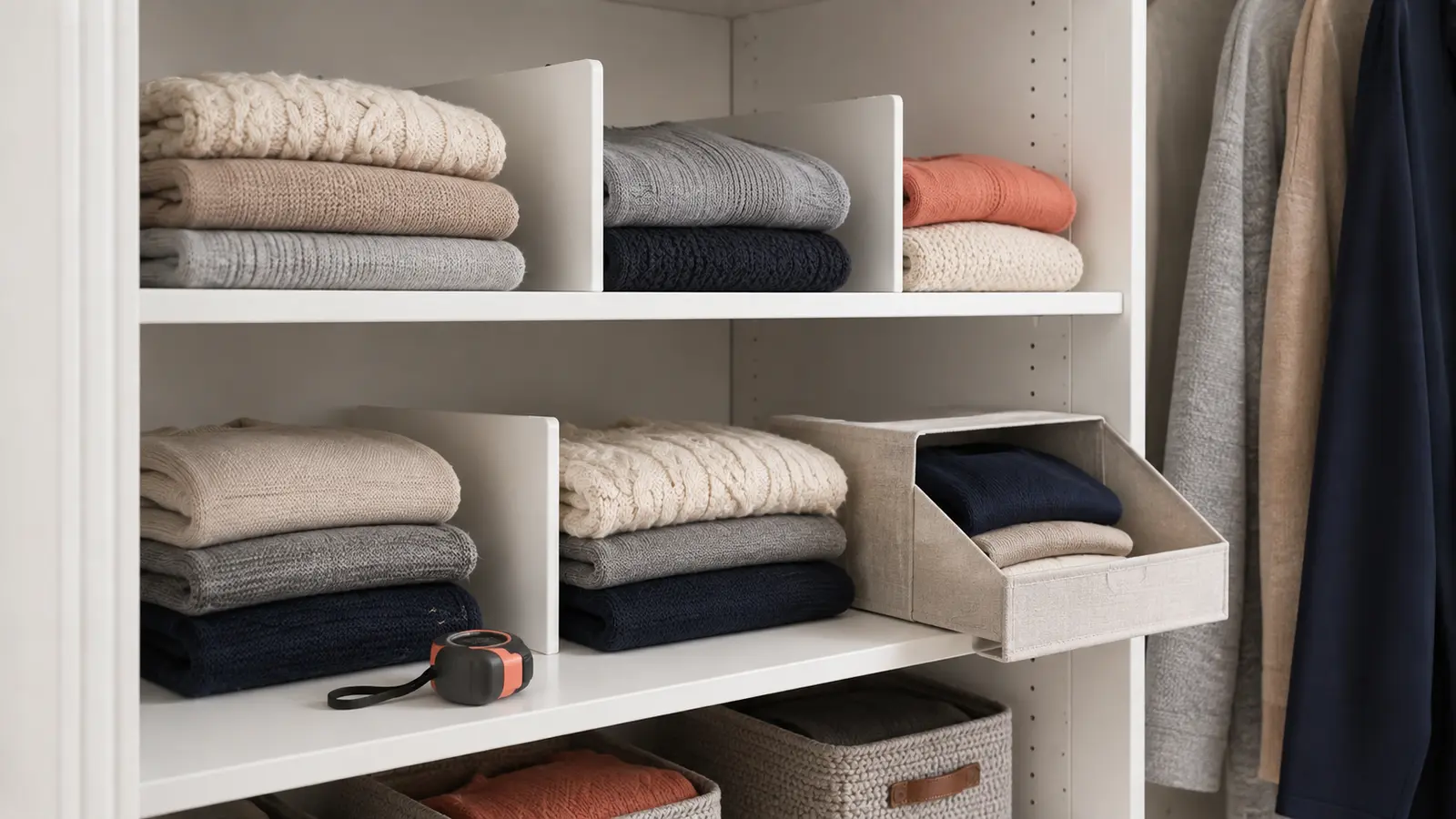
Organize closet shelves by giving each shelf one clear purpose and setting its height and depth around the actual items stored there. For most folded-clothing shelves, roughly 8 to 16 inches of clear vertical space is a useful starting range, but the right spacing depends on the category and the motion needed to remove it. Smaller, visible groups are easier to use than tall stacks or deep bins that hide their contents.
Closet shelf spacing: practical starting points
How much space should be between closet shelves? Start with the item, not a universal number. Published guidance varies by category: Elfa recommends 20–40 cm between shelves for folded clothes, while HomeGuide gives narrower category ranges for shirts, sweaters, shoes, boots, and bags. Use the ranges below as a first layout test, then measure your own items before moving or installing a shelf.
| What the shelf holds | Practical clear opening to test | Why you may need more or less |
|---|---|---|
| T-shirts and light folded tops | 10–12 in | Lower stacks reset more easily; bulky folds need more room |
| Jeans, pants, and medium folded stacks | 12–15 in | Dense stacks become unstable when pushed too high |
| Sweaters and bulky knits | 12–16 in | Thickness varies widely; avoid compressing soft stacks |
| Flats, sandals, and low shoes | 7–9 in | Check the tallest pair and the shelf lip or support |
| Ankle boots and high-tops | 12–14 in | Measure the footwear upright rather than using a shoe average |
| Handbags and small bins | 12–16 in | Handles, lids, and pull-out motion can require extra clearance |
| Seasonal bins | Bin height + removal space | Test the actual lid, grip, and path out of the closet |
These are planning ranges, not construction standards or guaranteed ergonomic clearances. Measure the clear opening from the storage surface to the underside of the shelf above. If the system is fixed, change the stack or container instead of forcing the category into a bad opening.
If the shelf is mainly for footwear, use the small-closet shoe storage guide to compare shelf space with floor, door, and hanging options before dedicating the zone.
Empty one shelf at a time
You do not need to dismantle the whole closet. Clear one shelf and group its contents into:
- Folded clothing
- Accessories
- Shoes
- Linens
- Seasonal or occasional items
- Items that belong elsewhere
Measure the shelf’s usable width, depth, and vertical opening. Include brackets, door trim, and the space needed to pull an item forward.
Match the storage method to the category
Folded clothes
Keep stacks low enough that removing one item does not collapse the rest. Dividers can help slippery or soft stacks, but they do not fix an overfilled shelf. If a category is large, split it by use—current rotation and backup, for example.
Small accessories
Use shallow containment that exposes the category at a glance. A deep opaque bin can turn belts, scarves, or small bags into an excavation task.
Shoes
Allow for the tallest and deepest pair in that zone rather than assuming every pair has the same profile. The dedicated small-closet shoe storage guide compares floor, shelf, door, and hanging options.
Seasonal items
These can occupy a high or less convenient shelf if the container is stable, reasonably light, and easy to identify. Do not store a heavy bin where it must be lowered from above shoulder height.
Use a front-to-back rule
Deep shelves tempt people to create two invisible rows. If the rear row is necessary, reserve it for the exact backup of the front category or use a pull-forward container that exposes the entire group at once.
Avoid placing unrelated daily items behind one another. The front item will become a permanent barrier.
Set shelf height with a test stack
Build a normal stack or place the intended bin on the shelf. Leave enough room to remove it without scraping the shelf above. Adjustable shelves are valuable because different categories require different openings; equal spacing often wastes vertical space.
Before moving or installing shelves, check the system manufacturer’s load and bracket instructions. Shelf material, span, fasteners, wall type, and load distribution all affect capacity, so a universal weight claim would be misleading.
Worked example: contents plus removal space
Imagine a folded stack that measures 8 inches high. In this hypothetical example, lifting and removing the top item needs another 2 inches, giving a 10-inch clear opening. Measure that opening from the storage surface to the underside of the shelf above, not between shelf centers. Shelf thickness is separate.
The 2-inch allowance is an example, not a minimum clearance or ergonomic standard. Test the motion with your own stack and grip. A lidded bin may need more room to lift its lid; a pull-forward bin may instead need a clear route beyond the shelf edge. If the shelf cannot move, reduce the stack or change containment rather than forcing it into the opening.
Visibility is not the same as reach
A clear bin can reveal its contents while still being difficult to retrieve from a high shelf. Test identification and retrieval separately: can you name the category from the doorway, and can you remove and replace it without reaching precariously or moving other daily items? Move frequent-use items to a comfortably accessible level. Do not climb on closet shelving or storage furniture.
Decide when a divider, bin, or drawer helps
| Organizer type | Best use | Main tradeoff |
|---|---|---|
| Shelf divider | Separating stable folded stacks | Does not contain small loose items |
| Open basket | Frequently used soft items | Contents may look visually busy |
| Opaque bin | Occasional items and visual calm | Hides contents; may need a label |
| Clear bin | Items that must remain visible | Visual clutter remains visible too |
| Pull-out drawer | Small items used often | Needs extension clearance and stability |
| Hanging cubby | Light folded items without drilling | Uses rod width and may sag |
Our closet organizer comparison explains how these types affect floor, wall, rod, and door space.
Keep the shelf resettable
A shelf system is maintainable when every category can be returned in one motion. If you must remove a lid, lift another box, or rebuild a perfect stack every day, the setup asks too much.
Try this weekly reset:
- Return stray items to their assigned shelf.
- Rebuild only stacks that lean.
- Remove empty packaging and donation items.
- Check whether any category is consistently overflowing.
- Adjust one boundary instead of reorganizing the entire closet.
Start with the full small-closet plan if shelves are only one part of a larger layout problem.
The finished-shelf test
From the closet opening, can you identify each category? Can you remove a daily item without moving another container? Can every bin come out through the actual door opening? If yes, the shelf is doing its job—even if some open space remains.