
Clothes Storage Ideas Without a Closet
Create clothes storage without a closet using a garment rack, drawers, under-bed space, and a visible daily rotation—without turning the room into storage.
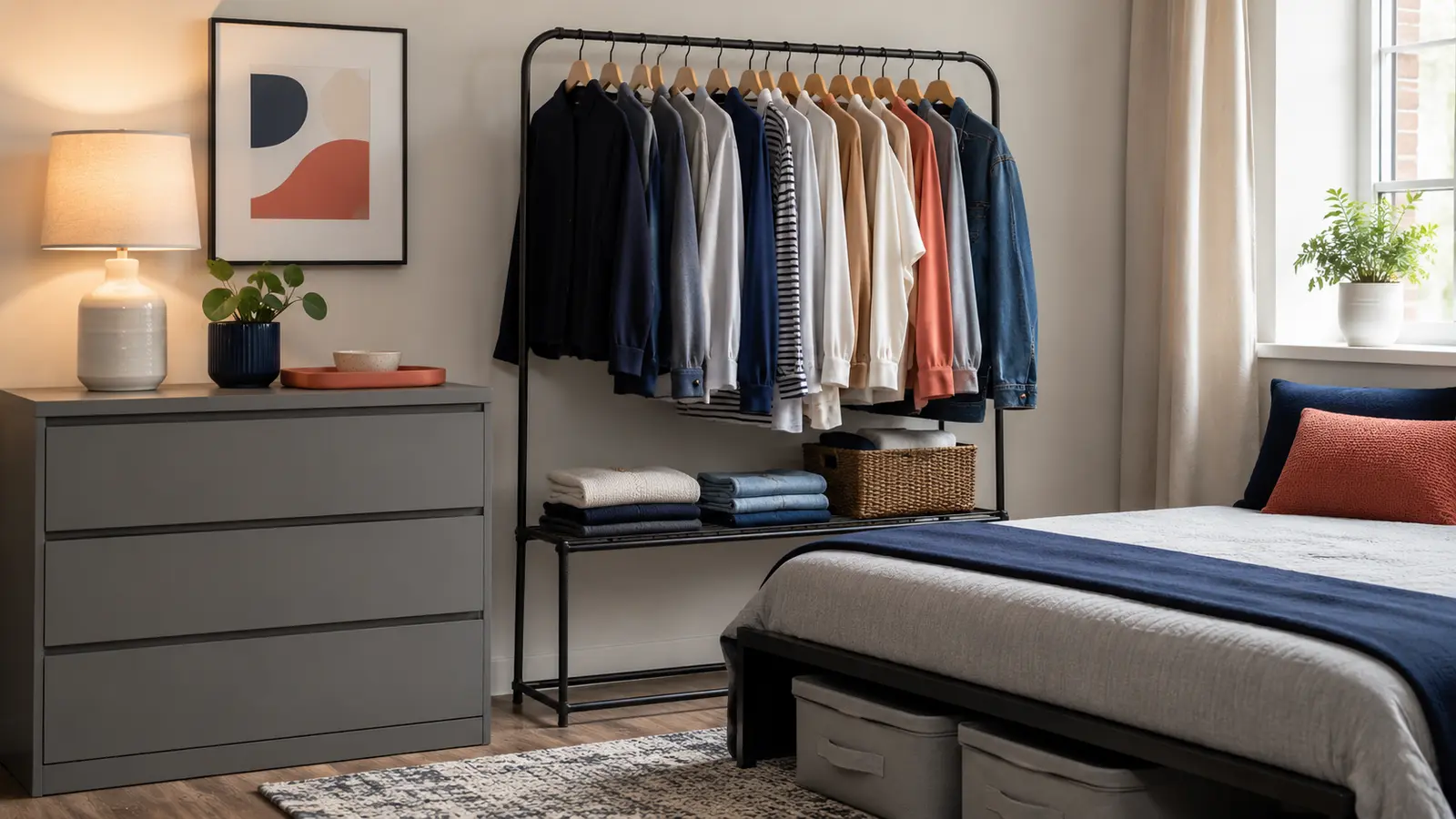
Without a closet, divide clothing storage into three jobs: hang wrinkle-prone daily pieces, contain folded categories, and protect seasonal items. A garment rack alone rarely solves all three.
7 clothes storage ideas when you have no closet
- A freestanding garment rack for the daily hanging rotation, not the entire wardrobe.
- A low dresser or drawer unit for underwear, socks, tees, and other folded daily categories—installed and anchored as required by the manufacturer.
- Under-bed containers for seasonal or lower-frequency clothing when the pull-out path is genuinely accessible.
- Open cubes or bounded shelf baskets for folded categories that need one-step visibility.
- Lidded boxes for protected occasion clothing that does not need daily access.
- A small hook rail for a robe, next-day outfit, or re-wear item—not as overflow storage.
- One defined storage wall or corner that keeps the rest of the bedroom visually and physically clear.
The best setup usually combines two or three of these rather than asking one piece of furniture to replace every closet function.
Inventory by storage need
Sort clothing into:
- Daily items that should hang
- Daily items that fold
- Small categories that need drawers or bins
- Occasion clothing
- Seasonal clothing
- Laundry and re-wear items
- Items leaving the wardrobe
This determines the combination of rack, drawers, boxes, and hooks. It also prevents every garment from becoming visible room decor.
Use a garment rack selectively
A freestanding rack gives immediate hanging access and can move with a renter. It also exposes clothes to dust and visual clutter and occupies floor area.
Choose a stable rack sized for the intended garments and follow its assembly and load instructions. Keep the base out of walkways. Do not treat the top bar as a substitute for unspecified shelves or extensions.
Hang the current rotation rather than the entire wardrobe. Matching hangers are optional; consistent spacing and an edited selection matter more.
Give folded clothes closed or bounded storage
A low dresser, cube unit, or bins can handle folded items. Choose the format by access:
- Drawers for small daily categories
- Open cubes for visible, easy-to-reset stacks
- Lidded boxes for protected occasional items
- Under-bed containers for seasonal or low-frequency clothing
Furniture with drawers, doors, or shelves can tip, not only tall units. Follow CPSC anchoring guidance and the manufacturer’s installation instructions. A lower unit or heavier contents do not replace required anchoring. If you cannot anchor the furniture, do not use it as a no-drill workaround.
Choose a setup for your room constraint
These are planning scenarios, not installations we have tested. Start with the constraint you cannot change, then assign each clothing category a place.
You cannot drill into the walls
Keep a limited hanging rotation on a freestanding garment rack only if its instructions permit freestanding use. Put occasional folded clothing in accessible under-bed bags or individual floor-level containers outside walking routes. Do not stack containers into a substitute wardrobe. If a rack or furniture unit requires anchoring, seek permission for correct installation or choose another storage approach; adhesive hooks are not substitute furniture anchors.
There is no room for a dresser
First mark the rack’s full base footprint and the hanging garments’ depth, not just the bar width. If drawers would obstruct the bed or doorway when open, reserve accessible under-bed storage for folded daily categories. Separate socks and underwear inside a shallow container so they do not mix with larger garments. If reaching under the bed is difficult, this is not a suitable daily-storage solution: reduce the room’s storage load or reconsider the furniture layout rather than adding inaccessible bins.
Under-bed space is limited
Map the usable pockets between supports instead of treating the whole bed footprint as available. Try one empty container through the actual pull-out route before buying a set. Assign the easiest pocket to one named category; do not assume the far side is reachable. Use correctly installed existing storage for the remainder. If the rack and available containers cannot hold the inventory without blocking movement, edit the stored wardrobe before adding another unit.
Make under-bed storage retrievable
Measure vertical clearance, usable width, bed supports, rug edges, and the pull-out path. Soft bags adapt to irregular gaps but can collapse; rigid boxes stack and protect better but require exact clearance.
Store clothing clean and dry. Use the area for items you can name and retrieve, not as an unsorted overflow zone.
Use hooks as a transition, not a wardrobe
One small hook rail can hold a robe, next-day outfit, or re-wear item. Set a capacity boundary. When every hook carries layers, the system has become another pile.
Create a visual boundary
Open storage feels calmer when it occupies one defined wall or corner. Keep the rack, dresser, and laundry zone aligned rather than scattering them around the room. Leave a clear path around the bed and doorway.
If you have a small closet but it cannot hold everything, the small bedroom closet system helps divide storage across the room. For organizer tradeoffs, see our closet organizer comparison.
A maintenance rhythm
Once a week, return clean clothes, clear the re-wear hook, and remove empty hangers. At the change of season, swap only the protected seasonal category instead of rebuilding the whole room.
The goal is not to imitate a built-in closet. It is to give hanging, folded, occasional, and transitional clothing one dependable home each.