
Small Pantry Organization Ideas: A Measurement-First System
Organize a small pantry by measuring shelf access, mapping a real grocery cycle, and adding storage only where it fixes a repeated visibility or retrieval problem.
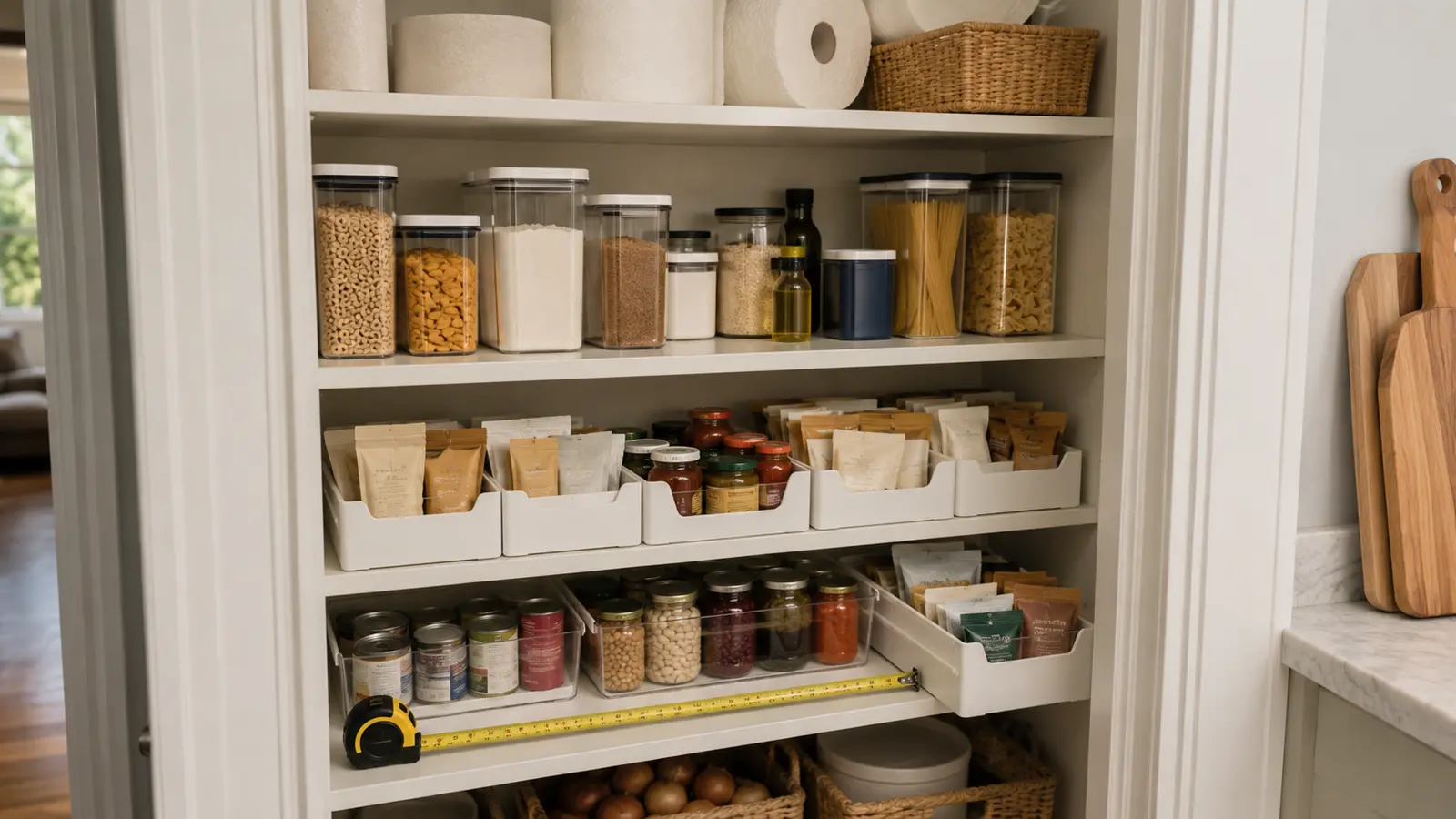
Small pantry organization works when every shelf is planned around what must fit, how often it is used, and whether it can be retrieved without moving unrelated items. Measure first, map one normal grocery cycle, and add an organizer only when it removes a repeated problem.
That order protects the limited space from a common mistake: filling it with matching bins before knowing which packages, quantities, and routines the pantry actually needs to support.
Take five usable measurements
Measure the pantry as it functions, not as an empty rectangle:
- Opening width: record the narrowest path a bin, appliance, or package must pass through.
- Usable shelf width and depth: measure between brackets, trim, pipes, and other obstructions—not only wall to wall.
- Vertical clearance: measure from the shelf surface to the shelf above, including any front lip.
- Door and retrieval clearance: open the door fully and check how far a container can slide or turn before it meets the door, frame, or an adjacent counter.
- Package dimensions: measure the largest recurring cereal box, oil bottle, snack bag, appliance, and bulk purchase that genuinely belongs here.
A container can fit on a shelf and still fail the pantry. It may be too wide for the opening, too tall to lift over a shelf lip, or too deep to pull forward when the door is open. Test that complete path before buying multiples.
When unusually deep fixed shelves are the main problem, use our deep pantry shelf guide to choose between full-depth lanes, risers, turntables, and mounted pull-outs.
Map one real grocery cycle
Use a recent grocery receipt, a normal week of meals, and the pantry stock you actually replace. This is more reliable than organizing an unusually empty pantry or stocking an idealized one for photographs.
Sort the inventory into four operating groups:
- Active: ingredients or snacks used most days
- Weekly: items used in regular meals but not every day
- Back stock: one or two replacements for products you reliably finish
- Occasional: baking, entertaining, seasonal, or specialty ingredients
Remove expired, damaged, unwanted, and incorrectly stored items before assigning space. Do not give permanent shelf space to an aspirational ingredient that has survived several resets without being used.
Assign zones by retrieval cost
The best location is not determined only by category. It is determined by how often someone reaches for the item, how heavy it is, and what must move to get it out.
| Pantry zone | Best use | Main test |
|---|---|---|
| Eye and hand level | Active cooking staples and daily snacks | Can it be identified and removed in one action? |
| Shelf above or below | Weekly ingredients and stable grouped categories | Can the group return without careful rearranging? |
| Lowest shelf | Heavy cans, bottles, and larger back stock | Is the load stable and easy to lift safely? |
| Top shelf | Light, bulky, occasional items | Can the item be reached without climbing or pulling weight overhead? |
| Back of a shelf | Like-for-like refills only | Does the front item clearly signal what is behind it? |
| Door, if compatible | Light, shallow packets or small bottles | Does the loaded rack clear every shelf and close securely? |
Keep back stock behind the same product rather than behind an unrelated category. The front item then acts as a visible cue instead of a barrier.
Choose an organizer by the failure it fixes
An empty bin is not added storage; it is another object occupying the pantry. Match each purchase to an observed failure.
| Repeated failure | First tool to test | Tradeoff to check |
|---|---|---|
| Small packets spread or fall | One shallow open bin or divided tray | Tall sides can hide short packets |
| Several identical cans disappear behind one another | A stable riser or one front-to-back lane | Check shelf height and the stability of the back row |
| Round bottles collect in a corner | A lipped turntable sized to the shelf | A large circle can waste rectangular space |
| Flexible bags collapse into each other | A low-sided pull bin | The bin must remain light enough to pull safely |
| One shelf has unusable height | A stable shelf insert | Verify fit and follow the maker’s load guidance |
| A staple spills or goes stale after opening | A food-safe airtight container | Keep the product identity, date, and safety information |
Use boxes or baskets you already own to test the footprint for a week. If the temporary version does not improve retrieval, a more attractive version will not repair the layout.
If packets fall between wires or organizer feet rock, follow the wire pantry shelf guide before adding a liner, bin, or riser. Surface support is a separate problem from category placement.
Apply the one-action rule
Count every movement between seeing an item and holding it:
- A daily item should normally require one action: reach and remove.
- A weekly group can require two actions: pull one bin, then take the item.
- Back stock may sit farther away, but it should never block an active category.
If you must remove one basket, balance it somewhere, reach behind another container, and rebuild the stack, the system is charging too much effort. Reduce the number of layers before adding more capacity.
Decant selectively, not automatically
Decanting can help when a recurring dry staple comes in a package that tears, spills, or cannot reseal. It is less useful when brands, package sizes, or ingredients change frequently.
If you transfer food, use a suitable food-storage container and retain the information needed to identify it: product name, ingredient and allergen details, relevant date, preparation directions, and lot or recall information. A uniform row of unidentified ingredients is harder to manage safely than the original packages.
Leave food in its packaging when the package already stores, pours, and reseals well. The goal is dependable use, not a fully decanted appearance.
Keep the pantry suitable for shelf-stable food
Storage location matters as much as organization. The U.S. Department of Agriculture advises keeping canned and other shelf-stable foods in a cool, dry place—not above or beside a stove, under a sink, in a damp area, or where temperatures become extreme. It also advises discarding leaking, bulging, heavily rusted, or deeply dented cans and following any “Keep Refrigerated” label. Review the full USDA shelf-stable food guidance for product-specific limits.
Do not use a prettier pantry layout to override the package instructions. Moisture, heat, damaged packaging, pests, or a required refrigeration label are storage issues, not organization problems.
Run a seven-day pantry test
Do not finalize the system on reset day. Use it through cooking, snacks, and one grocery restock.
At the end of the week, ask:
- Which items migrated to the counter or floor?
- Which category required moving something unrelated?
- Did any bin become too heavy or overfilled?
- Could everyone return items without interpreting narrow labels?
- Did the grocery restock fit without hiding older packages?
- Can the door close without pressing on a rack, bottle, or bin?
Buy only the components that answer a failure seen during this test. Leave a small amount of flexible space for changing packages and an ordinary restock.
Maintain it before shopping
The simplest reset happens before groceries arrive:
- Scan the active shelves and back stock.
- Add partly used ingredients to the next meal plan where practical.
- Check package condition and storage instructions.
- Move older matching products forward.
- Return migrated items and remove empty packaging.
This short inventory pass prevents duplicate buying more effectively than another label or container. A small pantry does not need to hold the theoretical maximum; it needs to make the current inventory visible, reachable, and easy to reset.