
How to Organize Deep Pantry Shelves Without Losing Food
Organize deep pantry shelves with pull-forward lanes, risers, turntables, and loaded movement tests that keep food at the back visible and reachable.
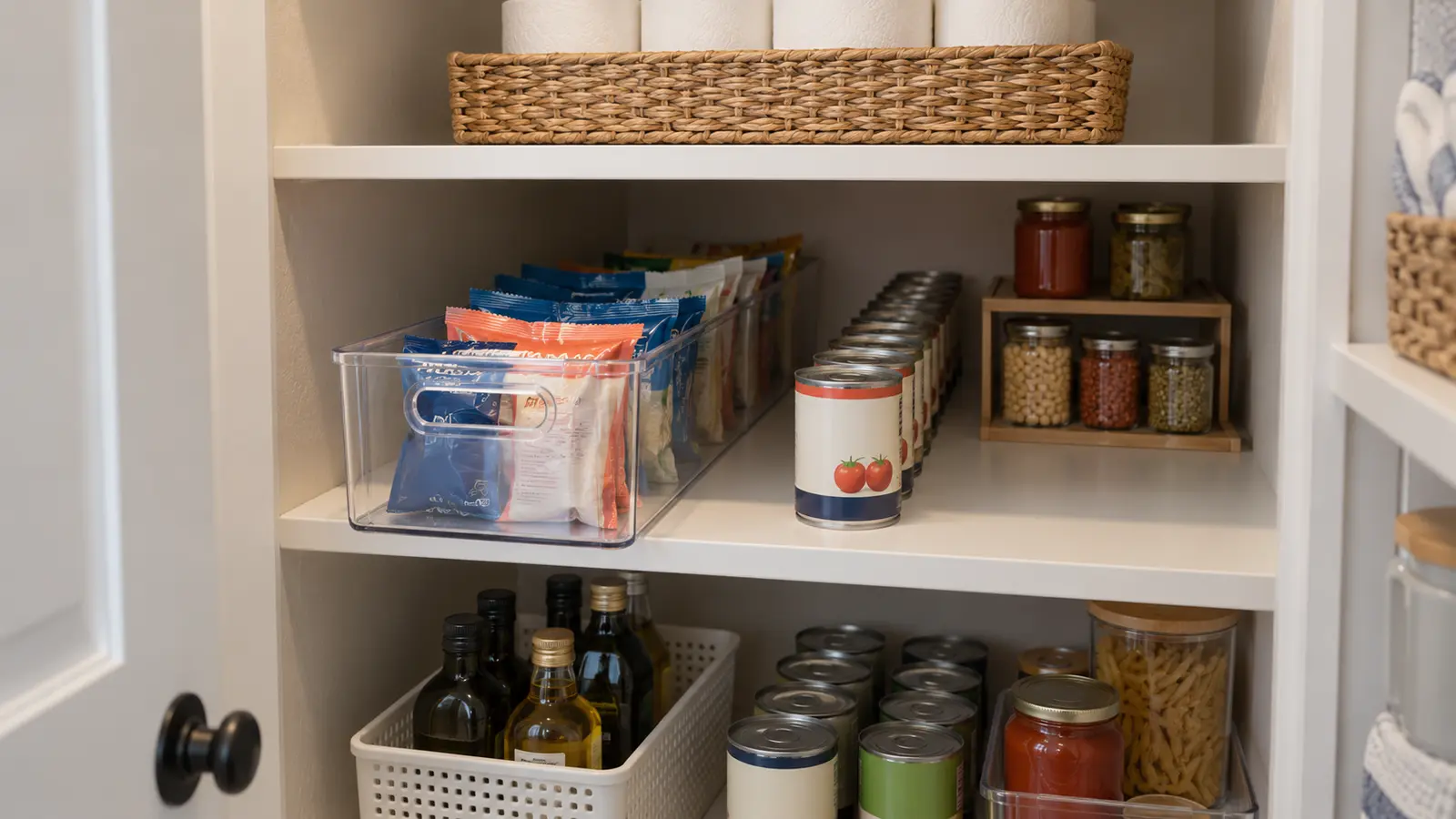
To organize deep pantry shelves, give every item at the back a defined way to come forward. Use full-depth lanes for lightweight groups, risers when height reveals the back row, turntables when rotation improves access, and pull-out hardware only when simpler tools cannot create a reliable retrieval path.
The goal is not to fill the entire shelf. It is to make its full depth visible, reachable, and easy to reset without unloading an unrelated category.
If the pantry still needs an inventory and zoning plan, begin with our small pantry organization system. This guide focuses specifically on the extra decisions created by deep fixed shelves.
Measure depth as a movement problem
Shelf depth alone does not tell you whether the back is useful. Record five measurements while the pantry door is open:
- Shelf depth: measure from the usable front edge to the back wall.
- Clear opening width: measure the narrowest path between trim, hinges, doors, brackets, or neighboring containers.
- Vertical clearance: include any front lip and the space needed to lift a bin or item.
- Outward pull clearance: check the door, wall, counter, and walking path in front of the pantry.
- Comfortable reach point: identify the deepest point you can reach and see without leaning on the shelf or removing another category.
The last measurement is the pantry’s retrievable depth. Any space beyond it needs a mechanism that brings items forward: a full-depth bin, a rotating platform, a riser that preserves visibility, or a properly installed pull-out.
Test that mechanism while loaded. An empty bin may glide through the opening but become awkward when filled with bottles, cans, or flexible packages.
Choose one retrieval motion for each zone
Deep shelves become easier to understand when each section has one predictable motion.
| Retrieval pattern | Best fit | What must be true | Main tradeoff |
|---|---|---|---|
| Slide a lane | Snack bags, pouches, baking packets, or another lightweight group | One full-depth bin passes through the opening and remains manageable when loaded | Tall sides can hide short items, and a wide bin may waste lateral space |
| Step the view | Repeated cans or short jars | A stable riser makes every row visible and leaves enough vertical clearance to remove the back row | Visibility does not help if the rear item is still beyond reach |
| Rotate the group | Bottles, jars, and other round containers | A lipped turntable can rotate fully without striking the wall, frame, or neighboring zone | A circle can waste the corners of a rectangular shelf |
| Pair front and back | Current package plus a matching refill | The front item reliably signals the identical product behind it | Unrelated products quickly become invisible in this arrangement |
| Pull out the shelf | A daily-use shelf whose back remains inaccessible | Hardware fits the cabinet geometry and is installed and loaded as directed | Higher cost, installation, lost side clearance, and possible renter restrictions |
Do not add every tool to every shelf. Choose the least complicated motion that fixes the repeated access failure.
Build lanes instead of hidden layers
A full-depth lane treats the shelf more like a drawer. The entire category moves forward together, so the back does not depend on memory.
Size each lane around the recurring packages it will hold—not around the shelf’s maximum dimensions. A useful pull bin should:
- fit through the narrowest opening without being tilted;
- have a reachable front handle or grip;
- clear the shelf above when lifted slightly;
- remain stable when extended to the point needed for access;
- stay light enough to pull, inspect, and return without bracing it elsewhere.
Keep one category or one closely related task in each lane. Baking packets can share a lane; a bag of rice should not sit in front of unrelated canned soup simply because both fit.
Two separate bins placed front to back usually preserve the original problem: the rear bin still requires removing and parking the front one. A single removable lane is more dependable when the shelf depth and package shapes allow it.
Make back stock explain itself from the front
The simplest use of a deep back zone is like-for-like reserve stock. Place the package in use or the one with the earlier relevant date at the front, with its matching replacement directly behind it.
Use three checks:
- The front package must identify what is behind it.
- A replacement should move forward as soon as the front package is removed.
- The amount of back stock should reflect a normal grocery cycle, not the maximum the shelf can hold.
If you cannot name the rear item by looking at the front of the shelf, it needs a pull-forward lane, a more visible position, or a different storage location. A label can identify a lane, but it cannot make a buried item easier to retrieve.
Use risers only when they improve reach as well as sight
Tiered risers work well for groups of similar-height cans and jars because the back row can rise above the front. Before keeping one, test the complete motion:
- Stand at the normal approach to the pantry.
- Confirm that every row is visible without moving the front row.
- Remove one rear item without striking the shelf above.
- Return it without shifting or destabilizing the riser.
Skip the riser if the back row becomes visible but remains too far away, or if the raised items sit too close to the shelf above. In that case, use a front-to-back lane or reduce the number of rows.
Avoid placing tall boxes in front of a riser. They recreate a visual wall and remove the advantage of the higher back row.
On wire shelving, also inspect where the riser’s feet touch. Our wire pantry shelf guide explains base support and liner compatibility; a visible rear row is not useful if its organizer rocks.
Use a turntable where rotation beats sliding
A turntable can convert a deep corner or bottle group into a rotating access zone. It makes the most sense for round containers that remain stable while the platform turns.
Measure the platform diameter against the usable shelf depth and nearby obstructions. Then load the actual bottle shapes and rotate it fully. A raised rim helps contain the group, but the rim must not hide short containers or catch their labels.
Skip a turntable for flexible bags, narrow boxes, or a shelf where the circular footprint leaves too much unusable space. A rectangular pull lane will usually use that geometry more efficiently.
Upgrade to mounted pull-outs only after a shelf fails the simpler test
Mounted drawers and sliding shelves can solve a genuinely inaccessible daily-use shelf, but they should not be the automatic first purchase. They add cost, installation requirements, hardware width, and a defined load limit.
Before selecting one, verify:
- the clear opening between hinges, doors, and face frames;
- the full depth and width available for mounting hardware;
- whether the door can open far enough for complete extension;
- the height of the loaded contents as the shelf moves;
- the manufacturer’s mounting surface, installation, and load instructions;
- landlord or lease permission when the installation is not reversible.
Renters—or anyone still testing the layout—can begin with standalone full-depth bins. If the same high-use shelf remains difficult through a normal grocery cycle, that repeated failure is stronger evidence for a permanent pull-out.
Load deep shelves by frequency and weight
Depth does not cancel the basic rules of safe, practical access:
- Keep frequently used items within the easiest visible reach.
- Store heavy bottles, cans, and appliances on a lower stable shelf and avoid burying them behind lighter packages.
- Reserve high shelves for light, occasional items that can be removed without pulling weight overhead.
- Leave enough open space at the shelf front for bins and rotating platforms to move.
The U.S. Department of Agriculture advises storing canned and other shelf-stable foods in a cool, dry place away from heat, moisture, and extreme temperatures. It also advises discarding leaking, bulging, heavily rusted, or deeply dented cans and following any package instruction that requires refrigeration. See the complete USDA shelf-stable food guidance for product-specific details.
Run a loaded retrieval test
Use the pantry at its normal fill level through cooking, snacks, and one grocery restock. The system passes only if the back remains accessible after real packages return.
Watch for these failure signals:
- a bin becomes too heavy to pull smoothly;
- a shelf lip or door blocks the movement;
- the front row hides a different product behind it;
- a riser displays the back row but does not make it reachable;
- a turntable cannot rotate without rearranging nearby items;
- older matching stock remains behind a newer purchase;
- someone must balance a container on the floor or counter to reach another category.
Fix the motion before buying another organizer. Narrow a lane, reduce back stock, relocate a heavy group, or leave more front clearance.
Reset the back before the next grocery trip
Before shopping, pull each deep lane forward, rotate each platform once, and scan the raised rows. Move matching older stock to the front, return migrated items, and note what is genuinely low.
This is the practical value of a deep shelf: it can hold an ordinary reserve without hiding it. Capacity becomes useful only when every rear item has a visible cue and a repeatable path back to the front.