
Bathroom Organization: Build a System That Stays Usable
Organize a bathroom by measuring usable storage, separating daily items from backups, protecting cleaning and moisture zones, and buying only for repeated failures.
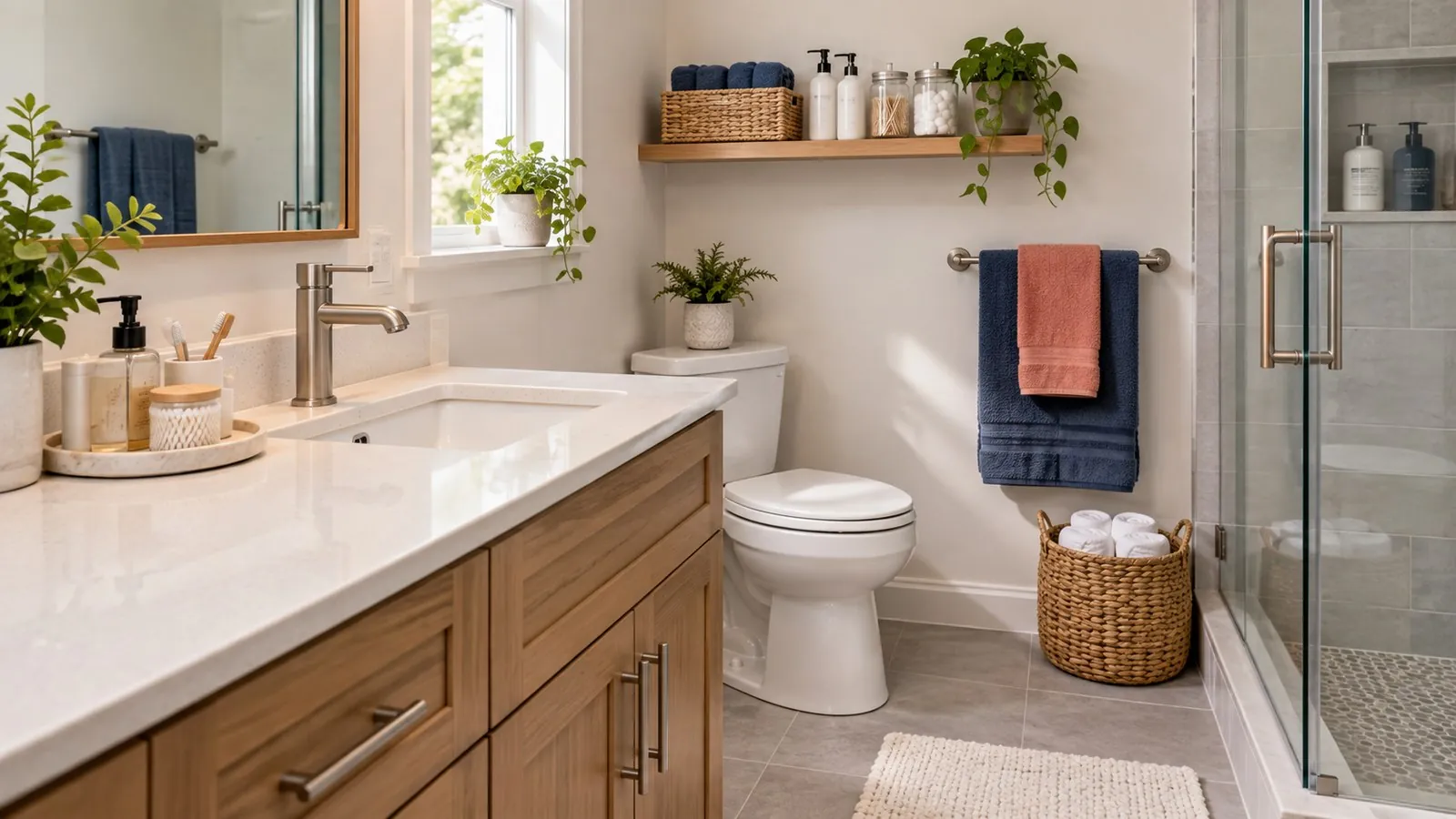
Good bathroom organization is not a contest to fit the most bins into the room. The goal is to make the bathroom easy to use, easy to clean, and easy to reset.
Use this order: decide what actually belongs in the bathroom, measure the storage that remains usable during normal movement and cleaning, assign daily/task/backup/safety zones, then add the smallest organizer that fixes a repeated problem.
If you are building a broader home system, start at the Home Organization hub and return here for the bathroom-specific method.
A quick bathroom organization plan
- Set the inventory boundary. Keep bathroom tasks in the room; relocate unrelated overflow and excess back stock when another sensible home exists.
- Measure usable space. Check cabinet and drawer interiors, opening paths, counter landing space, fixture/door movement, and cleaning access.
- Create four zones. Daily use, task-specific, backup, and cleaning/safety.
- Give the counter one job. Keep only items that genuinely earn immediate reach or a short drying/landing period.
- Contain by failure. Use a tray, divider, caddy, bin, or closed box only when it fixes mixing, tipping, migration, or retrieval friction.
- Run a normal-use reset. Get ready, shower or wash, put things back, wipe a surface, and confirm the system resets without moving three other things first.
The system is successful when the room works with fewer decisions, not when every shelf is full.
Start by deciding what belongs in the bathroom
Pulling everything out is useful only if you make an ownership decision before putting it back.
Sort the contents into four groups:
| Group | Typical examples | Storage priority |
|---|---|---|
| Daily use | toothbrush, current skincare, deodorant, hair tool used most days | easiest safe reach |
| Task-specific | shaving, occasional hair styling, bath items, guest setup | near the task, but not necessarily visible |
| Backup | unopened toiletries, spare paper goods, extra towels | lower-priority closed storage or another room |
| Cleaning / safety | bathroom cleaners and other products that need controlled access | secure storage based on household needs |
This is the first capacity gain: not every backup has to compete with today’s routine.
Medication needs a separate decision. The FDA says to follow the storage directions on the medicine label and notes that a damp bathroom cabinet can be improper storage for many medicines; a cool, dry location is often preferable. See the FDA’s medicine-storage guidance.
Do not force a medicine category into the bathroom simply because the room has a cabinet called a medicine cabinet.
Measure usable storage, not empty-looking space
A cabinet can look large while offering little useful storage once doors, plumbing, shelf height, and retrieval are considered.
Record these five checks before buying anything.
1. Internal cabinet and drawer dimensions
Measure the inside width, depth, and height where an organizer would sit.
For drawers, also measure the lowest obstruction above the drawer contents. A tall bin can fit the drawer box and still hit the vanity frame when the drawer closes.
For cabinets, measure around pipes, hinges, shutoff valves, shelf supports, and door hardware instead of treating the interior as one rectangle.
2. Counter landing space
The counter is working space, not free storage.
Protect enough clear surface to:
- wash and dry your hands;
- set down a current-use item briefly;
- wipe the surface without unloading a display of containers.
If a tray helps several daily items return to one place, it has a job. If the tray simply turns nine visible objects into one large visible object, it has not solved counter pressure.
3. Door, mirror, shower, and fixture movement
Open everything before deciding a nearby gap is storage.
Check:
- room door;
- vanity doors and drawers;
- mirrored cabinet;
- shower door or curtain path;
- toilet lid/tank access;
- nearby window;
- towel bars or hooks when loaded.
A shelf that fits with everything closed can still be in the way during normal use.
4. Cleaning and service access
Leave a realistic path to wipe the counter, clean the floor edge, reach plumbing, and notice a leak.
Storage that requires dismantling a stack before every wipe-down creates maintenance debt. In a bathroom, that debt arrives frequently.
5. Moisture exposure and drying
A bathroom is not a dry closet.
The EPA advises controlling bathroom moisture with ventilation, such as running the bathroom fan or opening a window when showering, and addressing leaks or recurring dampness rather than simply covering the problem. See the EPA’s mold and moisture guide.
That does not mean every bathroom needs special “waterproof organizers.” It means storage choices should be easy to wipe, able to dry in their actual location, and not block the room’s ventilation or cleaning routine.
Build four zones by access, not by matching containers
Once the usable space is mapped, assign jobs.
Daily-use zone
This is the easiest safe reach.
Use it for items that support the normal morning or evening routine. The zone might be one drawer, one shelf, part of a mirrored cabinet, or a small tray.
Do not give daily-reach space to unopened backups because they happen to be the same product category.
Task-specific zone
Group items around a distinct task: shaving, hair styling, nail care, bathing, guest setup, or another routine that is not used constantly.
A caddy can work well when the entire task moves together. A drawer section is better when the tools stay at the vanity.
Choose the format from the task, not from the container trend.
Backup zone
Backups should be visible enough that you do not accidentally rebuy them, but they do not need prime reach.
A closed cabinet, upper shelf, or storage outside the bathroom may be better than using the vanity’s easiest drawer for duplicate bottles.
If the room is small, reducing the amount of back stock stored there often creates more usable capacity than another organizer.
Cleaning / safety zone
The storage location has to fit the household, not only the floor plan.
If children can access the room, CPSC recommends keeping medicines and household cleaning supplies securely stored and out of reach, including locked storage where appropriate. See the CPSC poison-prevention guidance.
That can rule out an attractive open basket under the sink even if it fits perfectly.
Give the counter a strict job
Counters become cluttered because they are the easiest place to put something down.
Instead of asking “What organizer fits here?”, ask:
- What must be reached with wet hands?
- What needs a brief landing place while in use?
- What benefits from drying in the open?
- What is sitting here only because it has no assigned home?
Try to keep the counter as a working surface with a small daily-use zone, not a display shelf for the whole bathroom inventory.
This also makes it easier to notice spills, wipe the surface, and see when the system is drifting.
Choose containment by the failure it solves
An organizer earns its space when it removes a repeated failure.
| Repeated failure | Smallest useful response | When to skip it |
|---|---|---|
| small items migrate across a drawer | modular tray or shallow divider | when the organizer wastes more width than the items need |
| tall bottles tip or disappear at the back | contained upright bin/caddy | when pulling the whole bin blocks plumbing or another category |
| one routine uses several items together | portable caddy | when the caddy never actually moves and becomes a deep catch-all |
| backups mix with active products | separate closed bin or shelf zone | when the category is small eno… [truncated 4269 chars] |